Pearson Edexcel · A-Level · Economics B
Course version: 9EB0 · Version from Sept 2015
Quantitative skills: QS 7: make calculations to convert from money to real…
Full specification wording
Appendix 3: Quantitative skills: QS 7: make calculations to convert from money to real terms
Converting money (nominal) values to real terms is essential for comparing economic data over time without the distorting effects of inflation.
Checked against the Pearson Edexcel 9EB0 specification (opens in a new tab) on .
- Point 6 of 7
- 4 key terms
Study notes
From the checked teaching notes for this specification point.
The idea
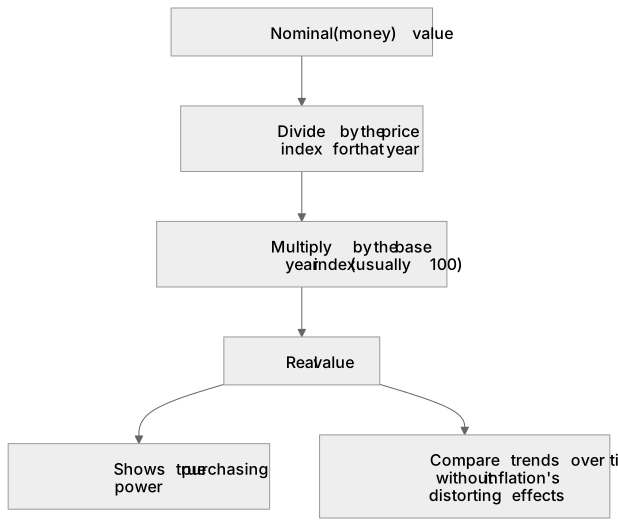
Converting money (nominal) values to real terms is essential for comparing economic data over time without the distorting effects of inflation. Nominal values reflect current prices, whereas real values are adjusted for price changes to show true purchasing power. To calculate a real value, divide the nominal value by the price index for that year, then multiply by the base year index (usually 100). For example, if a nominal wage is £30,000 and the Consumer Prices Index is 120, the real wage is (£30,000 / 120) × 100 = £25,000. This calculation reveals the actual quantity of goods the wage can buy. Mastering this skill allows you to accurately interpret trends in GDP, incomes, and interest rates by stripping out price level changes.
What earns the marks
- Identify the nominal (money) value and the relevant price index from the provided data.
- Apply the formula: (Nominal Value / Price Index) × 100 to find the real value.
- Calculate the percentage change in real terms over a given period to assess true economic growth or decline.
- Interpret the difference between nominal and real values as the impact of inflation or deflation.
Common mistakes and how to put them right
Multiplying the nominal value by the price index instead of dividing.
Put it right by dividing the nominal value by the index before multiplying by 100.
Confusing the base year index with the current year index.
Put it right: The base year index is always 100 and is used as the multiplier.
Assuming a rise in nominal value means an increase in purchasing power.
Put it right: Check if the inflation rate exceeds the nominal growth rate to determine the real change.
Exam tips
- Always state the formula you are using before substituting the numbers to ensure you pick up method marks if your final calculation is incorrect.
- Check whether the question asks for the real value in a specific year or the percentage change in real terms between two years.
- When comparing nominal and real GDP, remember that if nominal GDP grows slower than inflation, real GDP has fallen.
Try the lesson
The start of the Appendix 3: Quantitative skills: QS 7: make calculations to convert from money to real terms lesson, made from checked teaching notes for this specification point.
Have a go first
In 2022, a worker's nominal income was £30,000. The consumer price index (CPI) for 2022 was 120, with the base year being 2015 (Index = 100). What was the worker's real income in 2022, expressed in 2015 prices?
Listen
Converting money (nominal) values to real terms is essential for comparing economic data over time without the distorting effects of inflation. Nominal values reflect current prices, whereas real values are adjusted for price changes to show true purchasing power. To calculate a real value, divide the nominal value by the price index for that year, then multiply by the base year index (usually 100). For example, if a nominal wage is £30,000 and the Consumer Prices Index is 120, the real wage is (£30,000 / 120) × 100 = £25,000. This calculation reveals the actual quantity of goods the wage can buy. Mastering this skill allows you to accurately interpret trends in GDP, incomes, and interest rates by stripping out price level changes. A strong answer earns marks for these points. Identify the nominal (money) value and the relevant price index from the provided data. Apply the formula: (Nominal Value / Price Index) × 100 to find the real value. Calculate the percentage change in real terms over a given period to assess true economic growth or decline. Interpret the difference between nominal and real values as the impact of inflation or deflation. A common slip: Multiplying the nominal value by the price index instead of dividing. Instead, dividing the nominal value by the index before multiplying by 100. Exam tip: Always state the formula you are using before substituting the numbers to ensure you pick up method marks if your final calculation is incorrect.
See it
Key words
Say what each word means before you turn the card.
Real values
Try answering aloud or in your head before turning the card.
Nominal values
Try answering aloud or in your head before turning the card.
Purchasing power
Try answering aloud or in your head before turning the card.
Price index
Try answering aloud or in your head before turning the card.
See every definition
- Real values
- Values adjusted for price changes to show true purchasing power, found by dividing the nominal value by the price index and multiplying by the base year index.
- Nominal values
- Values that reflect current prices, rather than being adjusted for price changes.
- Purchasing power
- The actual quantity of goods a sum of money can buy, which a real value calculation reveals.
- Price index
- A measure used in converting nominal values to real terms, with the base year index usually set at 100.
Label the diagram
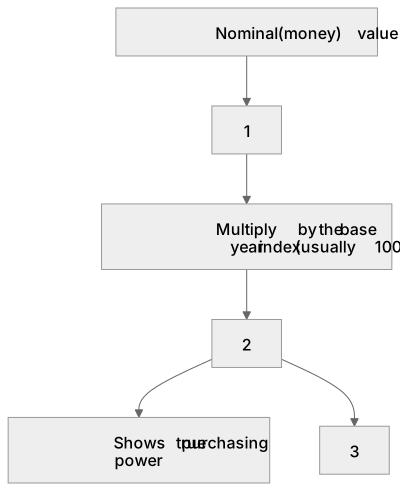
Some boxes have lost their names. Pick the right name for each number.
1Box 1
2Box 2
3Box 3
There is more to this lesson
The full lesson goes on to check your understanding and help you earn the marks. Create a free account to carry on, with your progress saved.
A week of Premium from your first lesson · Then the free plan continues · No card, no charge
Test your understanding of Appendix 3: Quantitative skills: QS 7: make calculations to convert from money to real terms
Active recall beats re-reading. Take an instant quiz now to test what you’ve learned and lock it into long-term memory.
A week of Premium from your first lesson · Then the free plan continues · No card, no charge